
Accurate quoting and job costing are essential to profitable tree work. Arborist businesses need to understand what a job is expected to cost before work begins—and what it actually cost once the crew, equipment and resources have been used.
JGID connects arborist quoting, estimating, job management, labour tracking and job costing so tree service businesses can move from estimate to completed job while maintaining better visibility over operational costs and profitability.
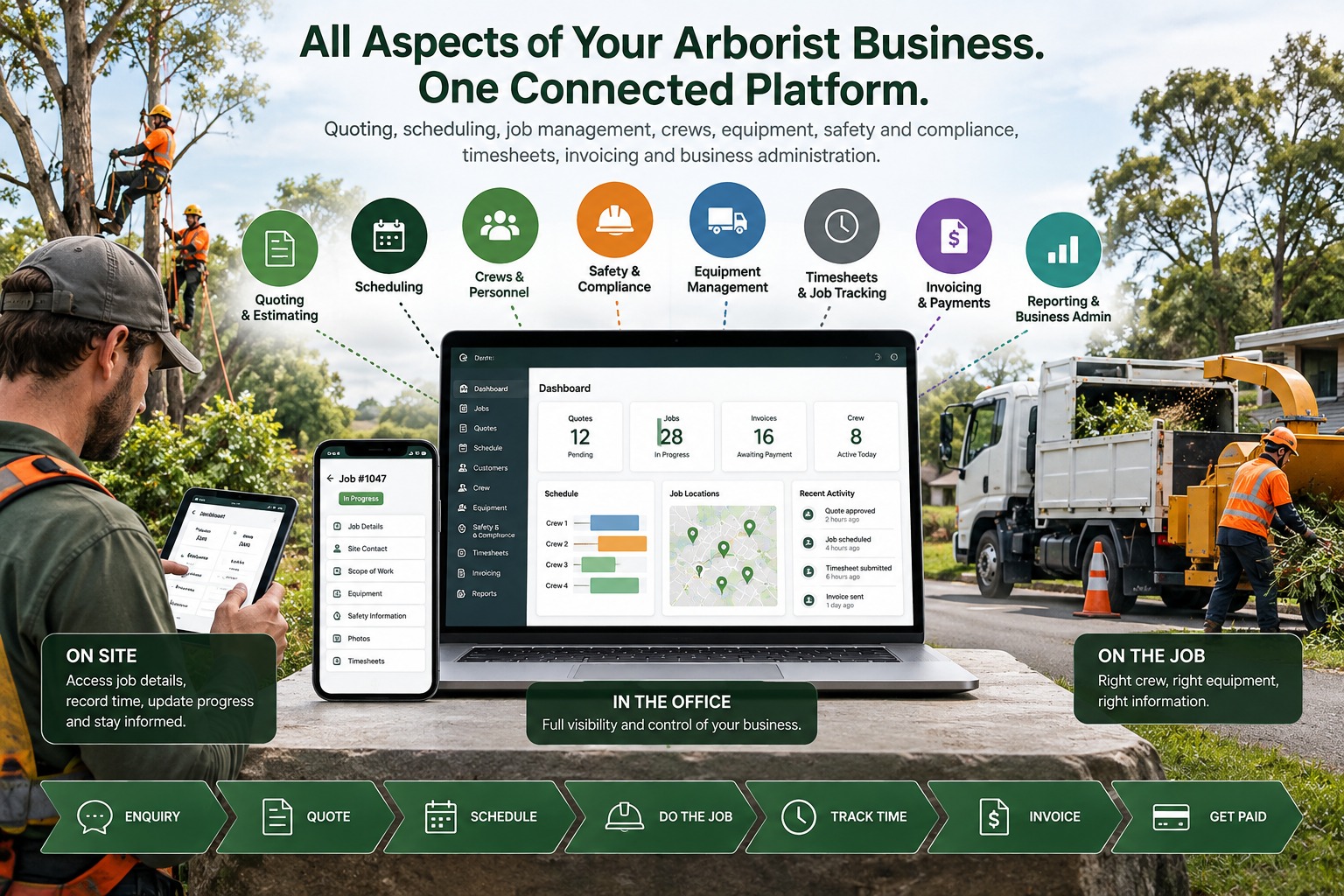
JGID job management software gives arborist businesses a central platform for quoting, scheduling, job management, crews, equipment, safety and compliance, timesheets, invoicing and business administration.
What Is Arborist Business Software?
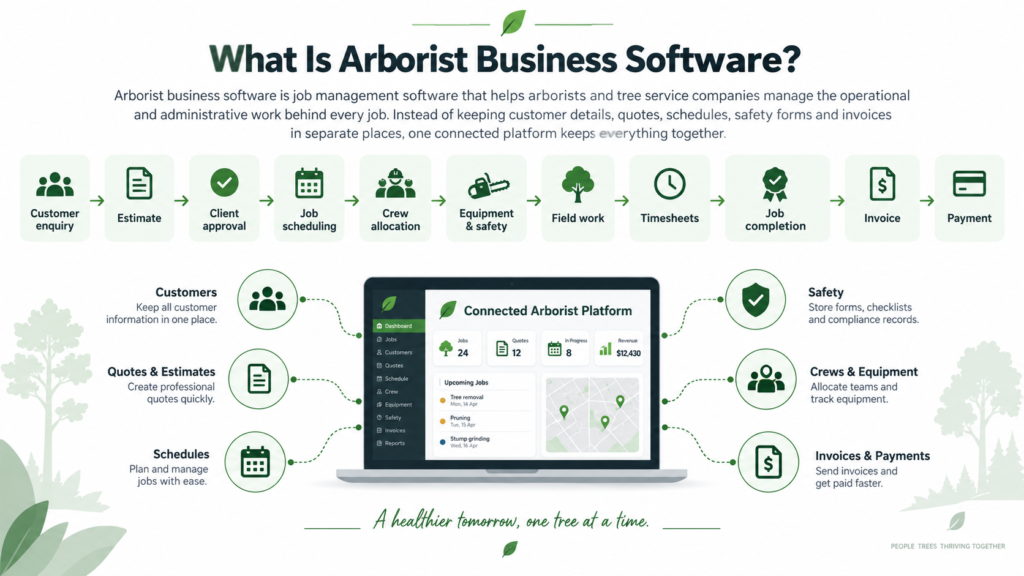
Arborist business software is job management software designed to help arborists and tree service companies manage the operational and administrative work behind every job.
Instead of keeping customer information in one system, quotes in another, schedules on a separate calendar, safety forms on paper and invoices somewhere else, an integrated platform keeps this information connected.
For an arborist business, the workflow can include:
Customer enquiry → Estimate → Client approval → Job scheduling → Crew allocation → Equipment and safety requirements → Field work → Timesheets → Job completion → Invoice → Payment
The objective is simple: give both the office and field teams the information they need while reducing repetitive administration.
For a deeper look at how digital systems are changing tree-care operations, see our guide to how arborist software transforms tree care operations.
Manage Your Arborist Business From Quote to Invoice
A tree service job can involve far more moving parts than an ordinary service call.
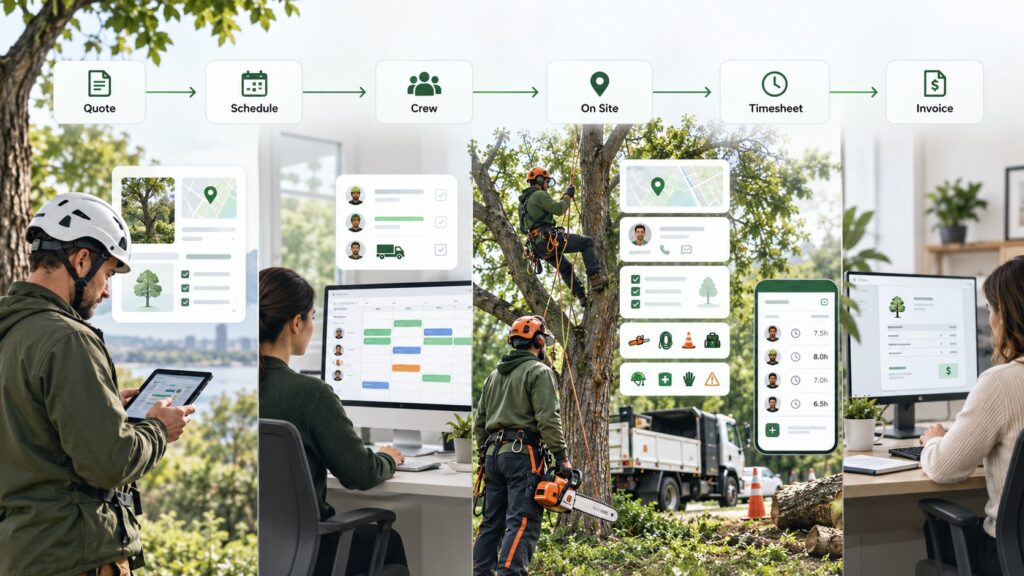
The estimator needs to understand the scope of work. The scheduler needs the appropriate crew available. Workers need the job location, site contact, scope, equipment requirements and safety information. The office needs accurate labour and job information before invoicing.
JGID connects these stages within one workflow.
An approved quote can progress into a job, the job can be scheduled to the appropriate team, job and safety information can be available to field staff, labour can be recorded against the work and completed jobs can move toward invoicing without repeatedly recreating the same information.
Explore the full range of JGID job management features.
Book a Personalized JGID Demo
Arborist Quoting Software for Faster, More Consistent Estimates
Accurate estimating is critical to the profitability of tree work. Before a crew arrives on site, an arborist business needs to understand the likely labour, equipment, time and operational requirements involved in completing the job safely and efficiently.
Every arborist job is different. Tree size and condition, property access, crew requirements, equipment, expected job duration, site hazards, disposal requirements and the complexity of the work can all influence the final price. When these factors are missed or underestimated, even a busy tree service business can find its profit margin reduced once the work is completed.
JGID arborist quoting software helps tree service businesses create more consistent, professional quotes using saved services, rates, descriptions, images, clauses and quote templates. This gives estimators a structured starting point instead of rebuilding every estimate from scratch.
Information already stored within the system can be reused when preparing new quotes, helping reduce repetitive data entry and maintain greater consistency across commonly quoted tree services. Customers can also approve quotes electronically, allowing accepted work to move more efficiently into the next stage of the job workflow.
Create Professional Arborist Quotes
A professional arborist quote needs to do more than provide a final price. It should clearly communicate the proposed work, help set expectations with the customer and give the operations team a reliable starting point when the job is approved.
Using a structured estimating process can help arborist businesses:
-
-
- maintain greater consistency between estimators
- standardise frequently quoted tree services
- reduce repetitive quote preparation
- provide clearer descriptions and scopes of work
- include relevant images and job information
- apply established rates and service information
- maintain a clearer record of customer approval
- move accepted quotes more efficiently into job preparation
-
For smaller tree service businesses, quoting may initially be handled by one owner or estimator who already understands the company’s pricing and operating requirements. As the business grows, however, multiple people may become involved in inspections, estimating, administration and job preparation.
This is where a consistent arborist estimating and quoting system becomes increasingly important. Rather than relying entirely on individual knowledge, handwritten notes or separate spreadsheets, estimators can work from information already maintained within the business system.
Consider the Real Requirements of Each Tree Service Job
A reliable estimate should reflect the actual resources likely to be required to complete the work.
Depending on the job, an arborist may need to consider factors such as:
-
- Tree size and complexity — Larger or more complex trees may require additional time, specialist techniques or additional crew members.
- Site access — Restricted access can affect how workers and equipment reach the tree and how material is removed from the site.
- Labour requirements — Crew size, expected working hours and the skills required can significantly affect the estimated cost.
- Equipment requirements — Different jobs may require different vehicles, machinery or specialist arborist equipment.
- Job duration — Estimating how long the work will take is essential when calculating labour and operational requirements.
- Hazards and site conditions — Difficult terrain, nearby structures or other site-specific risks may affect how the job must be completed.
- Waste and disposal requirements — Branches, timber and other material may need to be processed, transported or disposed of after the work.
- Scope of work — Pruning, tree removal, stump work and other arboricultural services can involve very different levels of time and complexity.
Capturing these factors during the quoting process helps create a clearer picture of what will be required before the work begins.
Book a Personalized JGID Demo
Connect Services, Equipment, Hazards and PPE
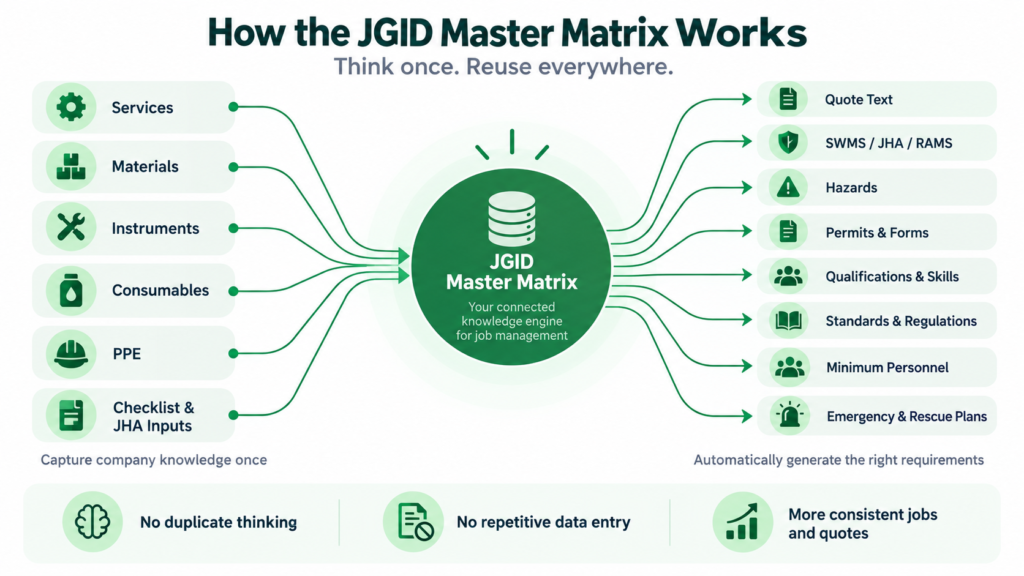
One distinctive component of JGID is the Master Matrix.
Rather than simply keeping separate lists of information, the Master Matrix allows relationships to be created between services and the resources or requirements associated with the work.
This can include equipment, hazards, PPE, qualifications, materials and other job requirements.
You can learn more about how the JGID Master Matrix works.
For an arborist company, this creates an opportunity to build operational knowledge into the system rather than relying entirely on individual employees remembering every requirement whenever a new job is prepared.
Arborist Scheduling and Crew Management Software
Scheduling tree work means balancing customers, job locations, workers, equipment and changing site conditions.
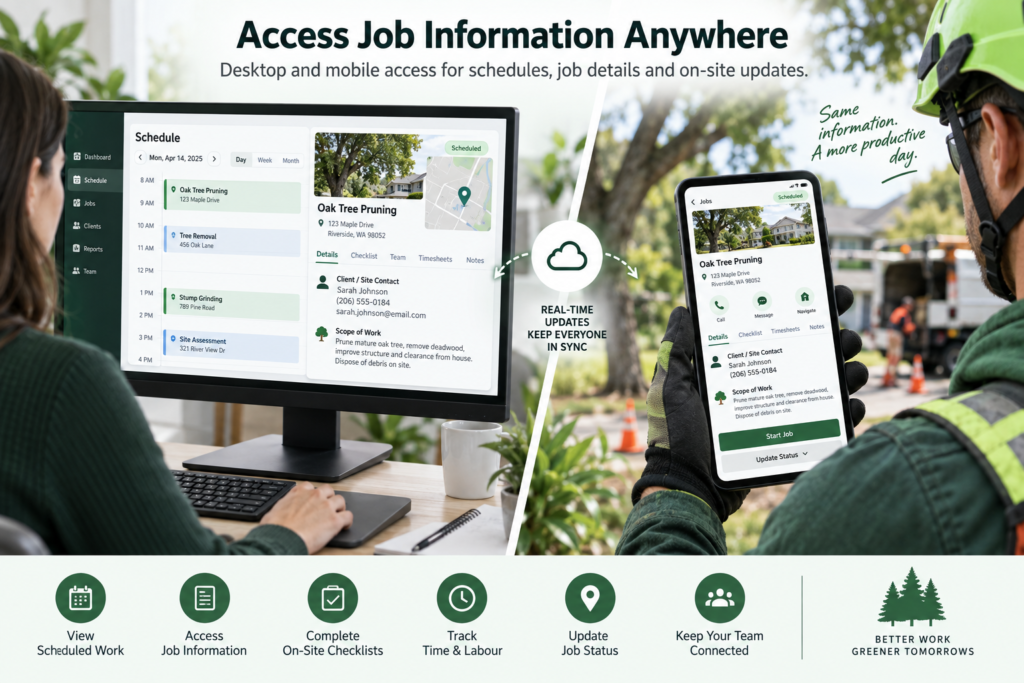
JGID includes drag-and-drop scheduling so jobs can be assigned to workers from desktop or mobile devices. Scheduled staff can access information connected with the job, including the scope of works, site address, site contact and relevant job information.
This creates a clearer connection between the office and the arborists carrying out the work.
Keep Arborist Crews Informed in the Field
Instead of relying on multiple phone calls, text messages or paper job sheets, workers can access relevant job information electronically.
Your field team can answer important questions such as:
-
-
- Where are we working?
- What work has been approved?
- Who is the site contact?
- What equipment is required?
- What safety requirements apply?
-
When the office and field teams are working from the same information, there is less opportunity for important details to disappear between quoting and job completion.
Mobile Arborist Job Management
Arborists work in the field, so business management software has to work outside the office.
JGID allows teams to access job information from mobile devices as well as desktop computers. Field workers can view scheduled work, access relevant job information and record work-related data while they are on site.
This gives office staff greater visibility while helping crews access the information they need closer to where the work is actually happening.
Safety, JHA and Compliance Management
Safety is a central part of professional arboriculture.
Tree work can involve climbing, working at height, chainsaws, rigging systems, mobile plant, electrical hazards, falling objects and changing site conditions.
Safe Work Australia provides specific guidance on managing the risks of tree work, including pruning, tree removal, wood chipping, stump grinding and other arboricultural activities.
In the United States, the ANSI Z133-2026 Safety and Health Requirements for Arboricultural Operations provides current industry safety criteria covering areas such as climbing, electrical hazards, vehicles, equipment, power tools and tree-care operations.
For that reason, arborist business software should do more than manage appointments and invoices.
JGID allows operational information such as JHAs, equipment requirements, staff qualifications and compliance information to form part of the wider job-management process.
Arborist Equipment and Inspection Management
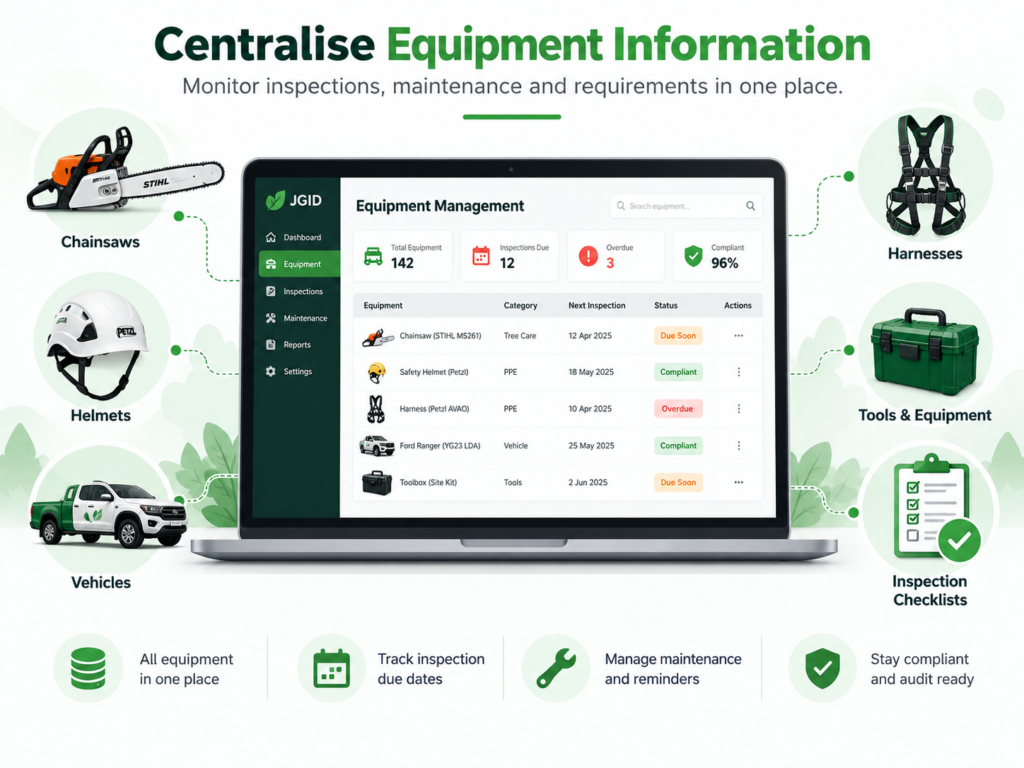
Tree service businesses may rely on climbing equipment, rigging equipment, chainsaws, vehicles, machinery and other assets that need to remain serviceable and appropriately managed.
JGID includes equipment-management functionality that allows businesses to centralise equipment information and monitor inspection requirements.
The system can also help businesses keep staff qualifications and other compliance information visible.
This is particularly valuable for businesses that have grown beyond the point where equipment and competency records can be reliably managed through spreadsheets, paper files and calendar reminders.
GPS Timesheets and Labour Tracking
Knowing how long a crew actually spends on a job is important for understanding labour costs and improving future estimates.
JGID provides job-based time tracking so workers can record their working hours against jobs.
Instead of reconstructing labour costs at the end of the week, accurate job-based time information gives managers better visibility into the resources actually used to complete work.
This information can also help identify jobs that consistently take longer than expected and provide better information for future estimating.
Arborist Job Costing Software: Which Jobs Are Actually Profitable
Running a profitable arborist business requires more than keeping crews busy. You need to know what each tree service job was quoted to cost, what it actually cost to complete, and how much profit was left when the work was finished.
JGID arborist job costing software connects quoting, labour, equipment, materials, scheduling, timesheets and invoicing so tree service businesses can see the true financial performance of their jobs. Instead of relying on spreadsheets or estimates after the work is complete, JGID helps you compare quoted costs against actual costs and use that information to improve future estimating and profitability.
JGID also brings the wider arborist workflow into one platform—from customer enquiries and quotes to crew scheduling, safety documentation, equipment management, job completion and invoicing.
A full schedule does not necessarily mean a profitable arborist business. A tree removal, pruning job or commercial maintenance contract can look profitable when it is quoted but lose margin when labour hours increase, equipment costs rise or unexpected job requirements appear.
Arborist job costing software helps you compare what you expected a job to cost with what actually happened.
With JGID, arborist businesses can bring job information together so managers have greater visibility over:
-
-
- quoted versus actual job costs
- labour hours and labour costs
- equipment and resource costs
- materials and project expenses
- subcontractor costs
- variations during the job
- job revenue and profitability
-
Compare Quoted Costs With Actual Costs
The real value of job costing comes after the quote has been accepted.
If a job was estimated to require eight labour hours but actually required twelve, that difference matters. If additional equipment or resources were required, those costs can also affect the final margin.
By comparing estimated and actual performance, arborist businesses can identify where jobs are consistently being underquoted or where operational costs are higher than expected.
Improve Future Arborist Estimates
Historical job-cost information also makes future estimating more informed.
Instead of relying entirely on experience or assumptions, estimators can review how similar tree removal, pruning or maintenance jobs performed previously.
Over time, this creates a feedback loop:
Estimate → Complete the Job → Record Actual Costs → Review Profitability → Improve the Next Estimate
For growing tree service businesses, this information can help management make better decisions about pricing, crew allocation, equipment use and the types of work the business should pursue.
Arborist Invoicing and Accounting
Completed jobs should not sit waiting because someone in the office still needs to reconstruct what happened on site.
Connecting operational job information with invoicing reduces unnecessary double handling and helps businesses move completed work toward billing more efficiently.
JGID integrates with Xero accounting software and also supports other integrations including Stripe. JGID’s current plans and available integrations can be reviewed on the JGID pricing page.
This creates a more connected process between operations, invoicing and financial administration.
Keep Arborist Customer Information Together
Good arborist CRM functionality involves more than maintaining a contact list.
Your team may need access to previous jobs, quotes, locations, customer contacts, photographs, documents and other information associated with the client.
Keeping this information connected gives your office more context when returning customers call and makes it easier to understand the history of the relationship.
This becomes increasingly useful for arborist businesses working with strata managers, commercial properties, councils, facilities managers or repeat residential customers.
What Should You Look for in Arborist Business Software?
The right system should reflect the way your tree service business actually operates.
Rather than comparing software solely on the number of features advertised, consider whether those features connect the complete operational workflow.
Useful arborist business software may need to support:
-
-
- Customer and enquiry management
- Estimating and quoting
- Electronic approvals
- Job scheduling
- Crew allocation
- Mobile job information
- Safety documentation
- Equipment and inspection management
- Employee qualifications
- Timesheets
- Job costing
- Invoicing
- Payments
- Accounting integrations
- Business reporting
-
The exact priorities depend on the size and complexity of the business.
A smaller arborist company may initially need better quoting, scheduling and invoicing. A larger operation managing several crews may place more importance on equipment, safety, qualifications, job costing and management visibility.
The important question is not simply “How many features does this software have?”
It is:
“Do these features work together across the entire arborist workflow?”
Why Use One System for Your Arborist Business?
Separate applications for quoting, scheduling, safety, equipment, timesheets and invoicing can appear manageable when a tree service business is small.
As the company grows, however, every separate system creates another location where information has to be entered, updated, checked and found.
An integrated arborist business management platform helps reduce those gaps by keeping operational information connected.
That can mean fewer spreadsheets, less repetitive administration, clearer job information for field crews and better operational visibility for managers.
JGID is designed around this connected approach.
Rather than treating quotes, jobs, employees, equipment, compliance and invoicing as unrelated processes, JGID brings them together within the wider job-management workflow.
See the complete JGID features and capabilities.
How Arborist Software Can Support a Growing Tree Care Business
Growth creates different problems from simply getting more enquiries.
Adding employees and crews means more jobs need to be scheduled, more equipment needs to be managed, more qualifications have to be monitored and more operational information needs to move between the office and the field.
Our related article, How Arborist Software Transforms Tree Care Operations, looks more closely at how moving away from disconnected manual processes can affect quoting, scheduling, safety and business administration.
This article is a useful supporting resource for arborist businesses considering the transition from spreadsheets and paperwork to a central job-management platform.
Who Is JGID Arborist Business Software For?
JGID is suited to arborist and tree service businesses that want to bring more of their operational information into one system.
It may be particularly relevant to businesses managing:
multiple workers or crews, one-off and recurring jobs, equipment and inspections, safety documentation, employee qualifications, field timesheets, customer records, quotes, job costs, invoices and accounting processes.
JGID already has a dedicated job management software page for arborist businesses where you can explore additional arborist-specific functionality.
Arborist Business Software That Goes Beyond Scheduling
Scheduling is important, but running a successful tree service business requires much more than putting jobs on a calendar.
You need visibility over what has been quoted, what the client has approved, what is scheduled, who is completing the work, what equipment and qualifications are required, what safety requirements apply, how long the job actually took and whether the work has been invoiced.
That is where an integrated job-management platform becomes more useful than standalone scheduling software.
JGID brings these processes together so arborist businesses have a clearer path from the first customer enquiry through to job completion and billing.
See How JGID Could Work for Your Arborist Business
Every arborist company has different services, crews, equipment, safety requirements and business processes.
The best way to determine whether arborist business software fits your operation is to examine how your own workflow could work within the platform.
JGID offers personalised demonstrations covering relevant areas such as job management, job costing, quoting, scheduling, personnel, equipment, compliance and reporting.