
Arborists make money doing arborist work such as climbing, cutting, chipping, and on-site consulting. That’s the billable stuff, but as a business grows, the person who used to spend their day in a harness ends up spending it instead building quotes from scratch, cross-checking who’s free on Thursday, re-typing job details from a notebook into a spreadsheet, and reconciling a stack of paper dockets from last week’s jobs.
None of that is billable, but all of it is necessary.
The more the business grows, the more of it there is, which means the owner or senior staff get pulled further and further away from the work that pays the bills and from the strategic thinking that could grow the business properly, rather than just keeping it afloat.
Is your information currently scattered everywhere?
You have a spreadsheet for quotes, a group chat for dispatching crews, paper job sheets and phone photos for site notes, a wall calendar or a basic digital one for scheduling, and separate accounting software for the invoices.
Individually, none of these tools is bad, but together, they’re a mess. Every one of those tools requires the same information to be entered separately. A job detail changes, and now it has to be updated in three or four places, and inevitably one of them gets missed. Site photos end up buried in someone’s camera roll, a scope-of-work change gets mentioned on-site but never makes it back to the office.
There’s no single source of truth, which means the business runs on tribal knowledge and whoever happens to remember what was said last Tuesday. That’s a liability waiting to surface at the worst possible time, usually in front of a client.
Why paper timesheets are costing you money
Manual timesheets feel like a minor inconvenience until you actually look at what they’re doing to your payroll. Workers filling in hours at the end of the week from memory, shift times rounded up “roughly,” and overtime that never gets properly logged. All of this is just what happens when time tracking isn’t tied directly to real, verifiable data.
The result is payroll processing that drags out every single week, arguments over hours that nobody can prove either way, and job costing that’s built on guesswork. You won’t know if a job made money or lost it, because the labour hours behind it were never accurate to begin with.
An important note on compliance
Arboriculture is dangerous work, and the compliance side of it (WHS standards, Job Hazard Analyses, Safe Work Method Statements, equipment inspections, staff qualifications, etc) isn’t optional box-ticking.
When all of that lives in spreadsheets or physical binders, it almost always gets managed reactively rather than proactively. Nobody wants to be the business that sent a worker out with an expired chainsaw ticket or ran machinery past its inspection date. When qualification renewals and equipment checks aren’t automatically flagged, that’s exactly what slips through, and the consequences range from a regulatory fine to something far more serious.
Connecting the workflow with quoting software for arborist businesses
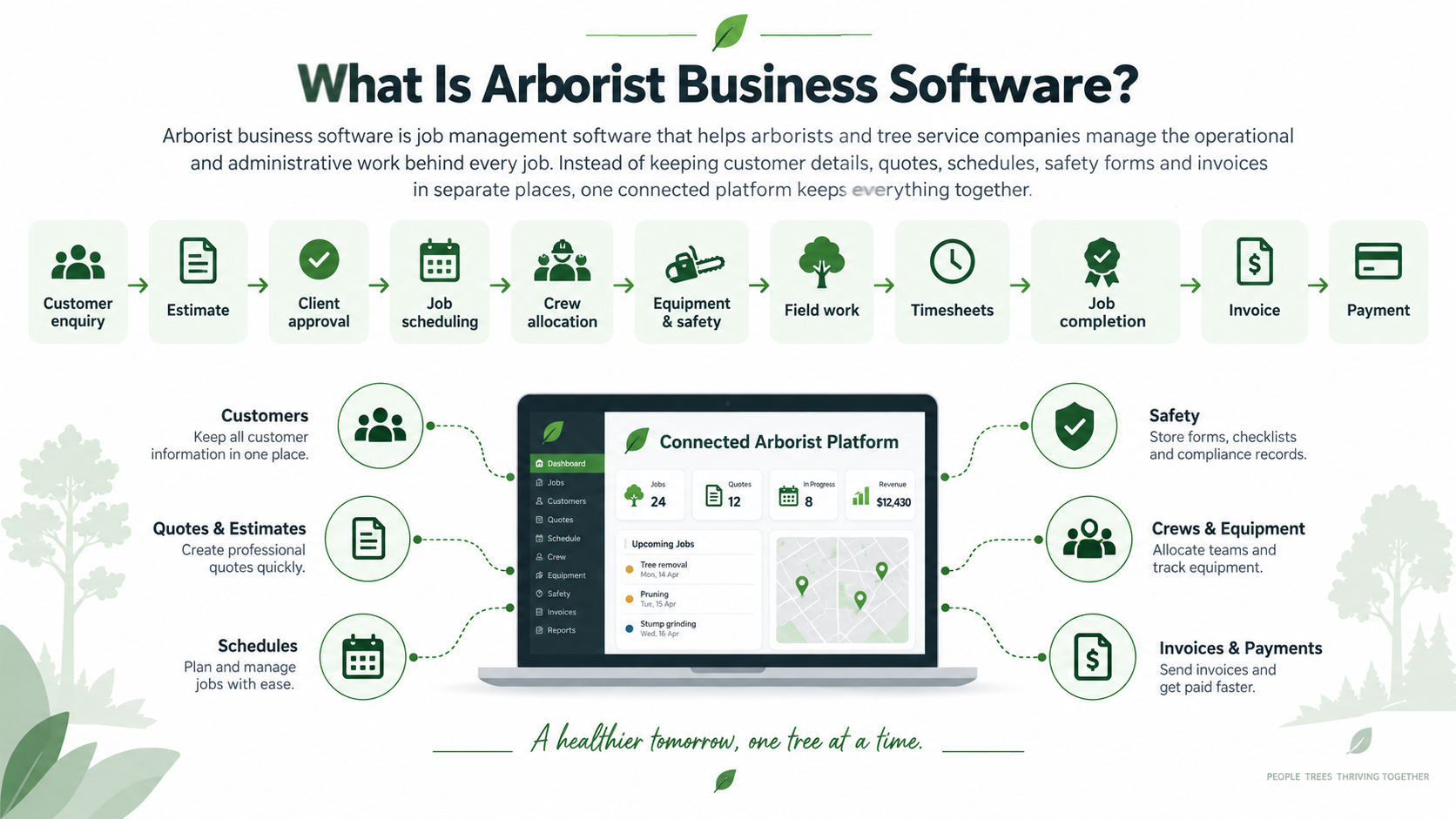
There are a lot of gaps mentioned above, and JGID has been built to close them. Rather than juggling separate tools for quoting, scheduling, field notes, timesheets, compliance, and invoicing, JGID connects the entire operational lifecycle in one place.
- A quote gets built from standardised templates and pre-composed items, then sent for digital sign-off
- Once approved, the job flows straight into JGID’s “Helicopter View,” a drag-and-drop scheduling board that gives you a real-time picture of every job, crew, and piece of equipment without a single phone call
- From there, everything syncs automatically to the mobile app, so crews arrive on-site with the address, contact details, scope of work, and gear list already in hand, along with the JHA and SWMS forms they need to complete before work starts, and built-in checks that confirm equipment and qualifications are current
- Time tracking happens through GPS-stamped mobile clock-ins, tied directly to the job, so payroll is based on fact rather than memory
- Once the work’s done, the crew lead gets a digital sign-off on-site, which converts into an invoice with one click, complete with an online payment option through Stripe, and automatic syncing with Xero so nothing needs re-entering.
This is tidier admin and every part of the job living in one connected system instead of five disconnected ones. That’s what lets a business scale: not working harder to manage more admin, but building a business that runs cleanly enough to grow without you having to hold it together by hand.
Software to manage arborist quotes and invoices for growth
You started (or grew) this business, presumably, to eventually get some breathing room with more revenue, autonomy, and maybe even a life outside of work. Instead, if the admin side hasn’t kept pace, growth just means more of everything: more transactions, communication, scheduling headaches, and compliance filings. You end up needing to hire more back-office staff just to keep the wheels turning, which eats straight into the margins that growth was supposed to deliver in the first place. Learn more about how JGID arborist business software can make all of this much simpler today.